Alleged 3.6GB Data Leak Claims to Expose Philippine DICT Internal Documents, Including Procurement and Budget Records
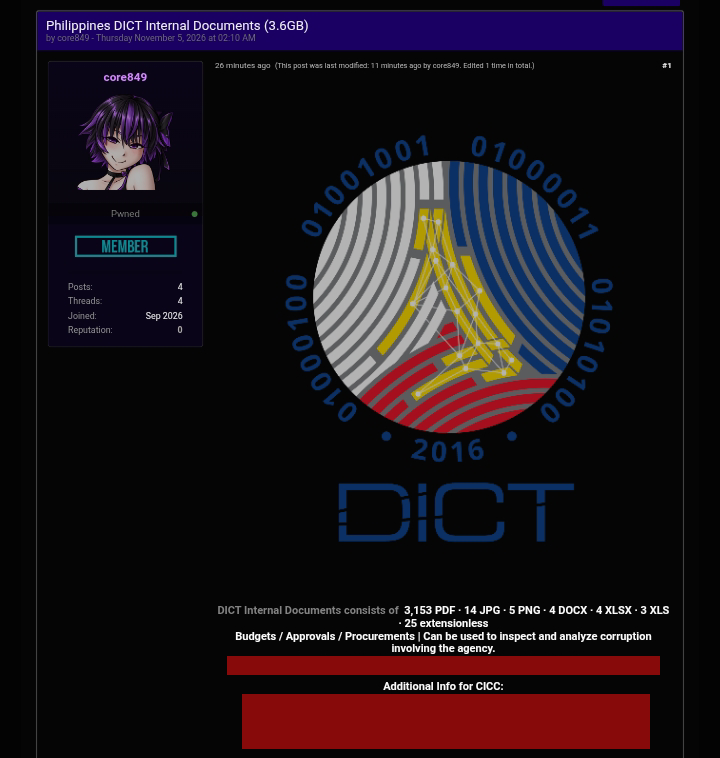
MANILA, Philippines — An alleged data leak involving the Department of Information and Communications Technology (DICT) has surfaced on an underground cybercrime forum, with a threat actor claiming to have obtained approximately 3.6GB of internal agency documents, including procurement-related records, budget information, and other administrative materials.
The listing, published under the forum account “core849” on November 5, 2026, is titled “Philippines DICT Internal Documents (3.6GB).” According to the threat actor's post, the allegedly compromised dataset contains thousands of documents and several types of files, which the poster claims could be used to examine procurement activities and possible irregularities involving the agency.
Based on the forum listing, the alleged dataset consists of 3,153 PDF files, 14 JPG images, five PNG images, four DOCX documents, four XLSX spreadsheets, three XLS spreadsheets, and 25 files with other extensions. The threat actor also included a preview of the purported materials and referenced additional information intended for the Cybercrime Investigation and Coordinating Center (CICC).
One of the samples provided appears to be a Market Research Result and Market Price Analysis Table concerning the procurement of an Active Cellular Identification and Cybersecurity System for ASEAN 2026 Security Operations.
The document contains procurement estimates and quotation comparisons attributed to three suppliers, identified in the sample as ADS, ARC, and Bowman. It covers five major procurement components: software and licensing, deployment and integration, training and capacity building, support and maintenance, and hardware and infrastructure.
The displayed figures include an estimated total Approved Budget for the Contract (ABC) of ₱160 million. The document also indicates an estimated 90-calendar-day delivery period, with a 45-calendar-day period listed for BAC procurement activities. It references a negotiated procurement approach and cites a government procurement resolution.
The procurement document is particularly notable because it provides a breakdown of estimated costs across the project's major components, alongside supplier quotations and delivery estimates. If authentic, these records could offer insight into the agency's procurement planning and the financial requirements associated with its cybersecurity operations for ASEAN 2026.