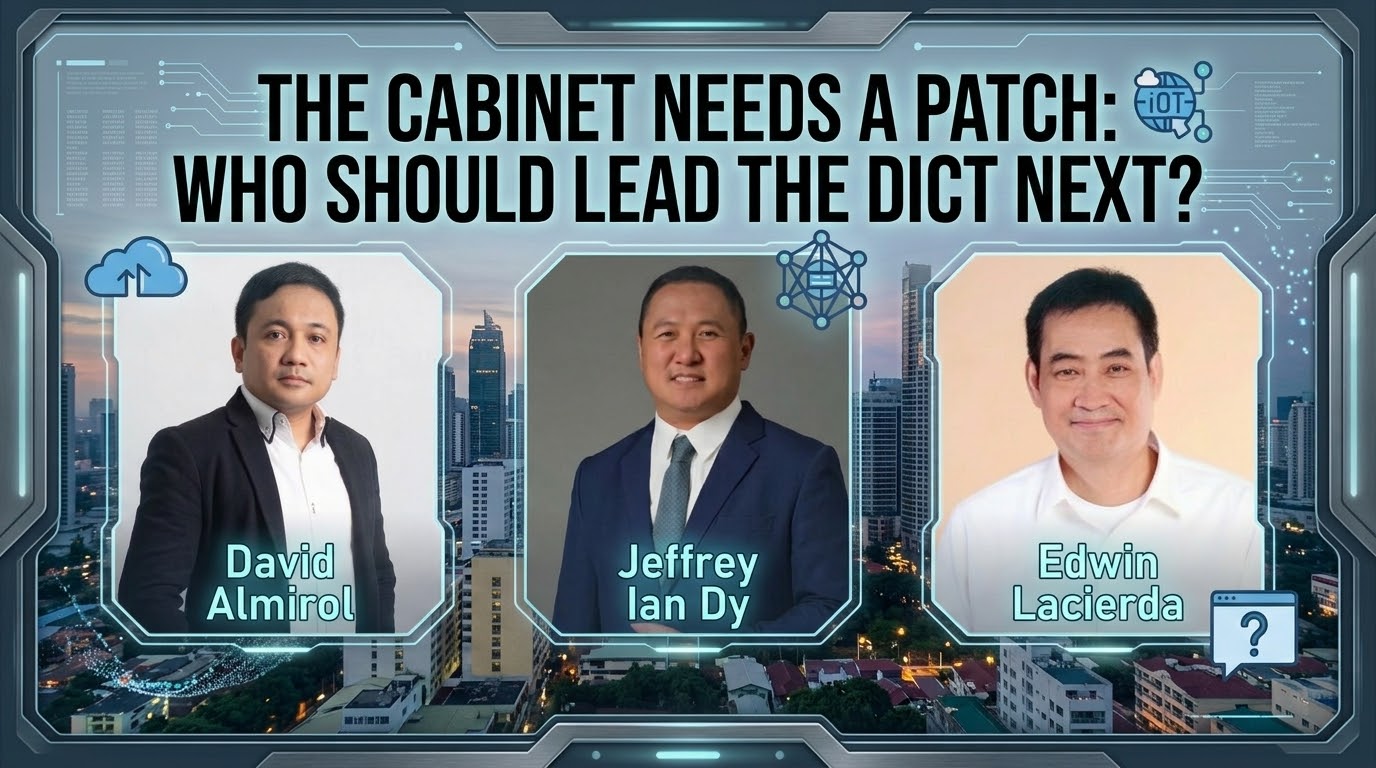
The Cabinet Needs a Patch: Who Should Lead the DICT Next?
The next DICT chief must do more than keep the system online. The country needs someone who can build it, secure it, and make the public trust it.
Following the acceptance of Henry Aguda's resignation, the search for the next secretary of the Department of Information and Communications Technology (DICT) is more than a routine Cabinet transition. It is an opportunity to determine what kind of digital leadership the Philippines needs at a time when government systems are expanding, cybersecurity threats are evolving, and public concerns over online safety continue to grow.
The next DICT chief must understand both sides of the country's digital transformation: building infrastructure that enables Filipinos to participate in the digital economy and securing that infrastructure against threats that can compromise government services, expose personal information, and endanger vulnerable users.
From telecommunications and broadband connectivity to cloud infrastructure, government platforms, cybersecurity operations, and data privacy, the department's responsibilities demand a leader who can translate technical knowledge into effective public policy. Equally important is the ability to work with industry, independent cybersecurity researchers, civil society, law enforcement, and child-protection advocates.
Among the names being considered in public discussions, David “Dave” Almirol Jr. stands out as a serious contender, particularly given his digital-government background and the encouraging response he received in a recent technology-community poll. However, his candidacy should be examined alongside other potential candidates, with the same attention to qualifications, limitations, and the challenges awaiting the next secretary.
Dave Almirol: A Strong Contender with Digital-Government Experience
Almirol brings a combination of technology entrepreneurship and government experience. As founder of Multisys Technologies and currently the DICT undersecretary for E-Government, he has been involved in software development and the implementation of digital platforms intended to make government services more accessible and efficient.
This background matters. Digital transformation is not simply about launching applications or putting government forms online. It requires integrating systems, reducing duplication, managing infrastructure costs, improving service delivery, and ensuring that digital services can operate reliably at scale.
Almirol's experience in both the private and public sectors gives him a perspective on the challenges of turning technical solutions into operational government services. His work in e-Government also places him close to one of the department's most visible responsibilities: making digital public services useful to ordinary Filipinos.
There is also a notable signal of public interest in his candidacy. In an informal Facebook poll conducted by TechWatch Philippines from October 6 to 11, 2026, Almirol received 602 of 855 reactions, or approximately 70.4% of the total. Former presidential spokesperson Edwin Lacierda received 126 heart reactions, while CICC Executive Director Renato “Aboy” Paraiso received 25 care reactions.
Although this was not a scientific survey and cannot establish the position of the entire Philippine IT community, it offers a concrete indication that Almirol attracted substantial support among participants in a technology-focused discussion about Aguda's possible successor. That response deserves attention, but it should not be mistaken for proof of nationwide professional consensus.
His candidacy also comes with important expectations. Digital-government experience does not automatically establish expertise across every area under DICT, particularly telecommunications infrastructure, national cybersecurity operations, and critical infrastructure protection. The next secretary must demonstrate that digital services are not only convenient but also resilient, secure, privacy-conscious, and accountable.
Almirol would therefore need to show how his experience can translate into a department-wide cybersecurity strategy, stronger incident response, better protection of government data, and sustained investment in technical personnel. The government must also be willing to measure the results of his leadership through clear security and service-delivery outcomes.
Nevertheless, his combination of technology entrepreneurship, digital-government experience, and the visible support reflected in the recent poll makes him a credible candidate for serious consideration.
2. Jeffrey Ian Dy: A Stronger Focus on Information Security
Jeffrey Ian Dy offers a different professional profile, with experience in information security and government ICT administration. His background and more than two decades of experience in technology and information security.
As a former DICT Undersecretary, Dy has experience in areas associated with infrastructure management, cybersecurity, connectivity, and digital development. This background is relevant to the technical and operational challenges facing the department, particularly as government agencies become increasingly dependent on interconnected systems.
His profile is especially pertinent to improving cybersecurity governance, incident response, threat detection, and the protection of sensitive government information. A secretary with substantial information-security experience could help ensure that cybersecurity considerations are integrated into digital infrastructure projects from the beginning rather than treated as an afterthought.
However, the secretary's responsibilities extend beyond technical security. The role requires managing a large institution, overseeing programs and budgets, coordinating with other agencies, and balancing national priorities with the needs of citizens and the private sector.
Dy's candidacy should therefore be assessed through both his technical qualifications and the measurable results of his previous government work. His experience offers a relevant foundation, but his capacity to lead the department's full digital-transformation agenda must be considered alongside it.
3. Edwin Lacierda: Governance and Industry Engagement
Edwin Lacierda presents another potential leadership profile, drawing on his experience in law, government communications, and engagement with the technology sector. His tenure as presidential spokesperson under the late President Benigno Aquino III gave him experience in executive communications, policy explanation, and public accountability.
These capabilities are relevant to a department whose decisions can affect millions of users, businesses, and government employees. Digital policy often requires coordination between agencies with different mandates, negotiations with technology providers, and clear communication about the benefits and consequences of government decisions.
Lacierda's background could be useful in strengthening those relationships and ensuring that ICT policies are communicated clearly to the public. His experience also provides a different perspective from candidates whose professional careers have been more directly focused on software development or information security.
The key consideration is whether his qualifications and technical experience satisfy the demands of leading the DICT. Publicly documented governance and communications experience should not be treated as a substitute for the ICT expertise required by law. His suitability would depend on demonstrating the necessary technical qualifications and the ability to oversee the department's infrastructure and cybersecurity responsibilities.
His profile merits consideration, but the assessment must establish whether his experience matches the technical requirements of the office and whether he can effectively lead specialists responsible for the country's digital systems.
Regardless of who is appointed, cybersecurity must become a central pillar of the DICT's leadership agenda.
The country continues to face risks involving ransomware, credential theft, data breaches, attacks against public-facing systems, and the misuse of emerging technologies. These threats require more than reactive incident management. They call for better threat intelligence, security assessments, coordinated incident response, stronger protection of government networks, and a sustainable workforce of qualified cybersecurity professionals.
The protection of children deserves particular attention. Online sexual abuse and exploitation, grooming, sextortion, predatory communities, and AI-generated abusive imagery demand sustained cooperation between technology platforms, law enforcement, child-protection institutions, and independent researchers.
Blocking a platform may sometimes be necessary under appropriate circumstances, but restrictions alone do not dismantle abusive networks. Effective responses require lawful investigations, evidence preservation, coordination with service providers, and the ability to identify how offenders move between platforms and services. Policies must also protect children's privacy and avoid unnecessarily restricting legitimate online activity.
The next secretary should be capable of evaluating whether government interventions are effective, proportionate, and supported by evidence. This means listening to technical specialists, engaging independent researchers responsibly, and measuring success through tangible improvements in public safety and cybersecurity rather than announcements alone.
Meeting the legal threshold is only the starting point. The next secretary should demonstrate the ability to manage infrastructure development, improve government digital services, strengthen national cybersecurity, and coordinate effective responses to emerging threats.
Almirol's digital-government experience and the strong response in the TechWatch Philippines poll make him a compelling contender. Dy offers a profile with a more explicit emphasis on information security and technical operations. Lacierda brings governance, communication, and industry-engagement experience. Each offers a different combination of strengths, and each should be evaluated against the same legal and operational standards.
The informal poll is a useful indicator of sentiment among its participants, not a mandate from the entire IT community. The decisive questions should concern each candidate's qualifications, record of delivery, management capability, and plans for the department.
Ultimately, the next DICT chief must do more than launch new platforms or respond after systems are compromised. The position requires someone who can build digital services that Filipinos can access, infrastructure that institutions can depend on, and security capabilities that can keep pace with evolving threats.
If anyone can pair their digital-government experience with a credible, measurable commitment to cybersecurity and public accountability, he deserves serious consideration for the post. The country needs a leader who understands that building a digital Philippines and protecting it are not competing priorities. They are two parts of the same responsibility.